





Investing in language training is an increasingly common decision among companies that work with international clients, suppliers, or teams. But when it comes time to review the training budget, an inevitable question arises: What return is this investment actually generating?
Figuring out how much an English program for employees costs is relatively simple. It’s much more difficult to determine the actual value it’s generating for your company—not just the decision to implement the program, but how the results being achieved are making a difference. An improvement in language proficiency can translate into greater autonomy, more effective communication with international clients, less reliance on third parties, or a greater ability to take on new responsibilities.
That’s why measuring the ROI of language training isn’t just a matter of applying a formula. The real challenge is establishing a connection between the training, the skills acquired, and the results the company needs to achieve.

What is the ROI of language training?
ROI stands for Return on Investment, that is, the return on investment. In the field of training, this metric allows you to compare the investment made with the financial benefits that can be attributed to the results obtained.
The basic formula is:
ROI = [(profit earned – investment) / investment] × 100
For example, if a company invests €20,000 in a corporate language training program and generates €30,000 in profits attributable to that investment, the ROI would be 50%.
However, with online language courses, the issue doesn’t end with the formula. The main challenge lies in determining which results can actually be attributed to the training.
If an employee improves their English, that learning can have consequences that do not immediately appear on the income statement. They may participate directly in a meeting with a foreign client, handle documentation independently, collaborate with an international team, or take on a position for which they previously lacked the necessary language skills.
That’s why, to accurately measure the ROI of a language program, you have to look beyond the cost of the course.
Why is it important to measure the ROI of language training?
For a long time, training programs have been evaluated primarily through activity metrics: number of enrolled employees, hours completed, courses finished, or participation rates.
This data is useful for managing a program, but it doesn’t answer the question that truly matters to management: What has the company gained from this investment?
Measuring ROI allows you to align training with the organization’s goals and make better decisions about the available budget. It also helps identify which programs work best, which employee profiles need more support, and where there are opportunities for improvement.
When it comes to languages, this assessment is particularly important because a person’s language proficiency can directly affect their ability to function effectively in certain professional contexts.
A company seeking to expand internationally, for example, may need certain employees to be able to negotiate, present products, serve customers, or collaborate with international teams in another language.
In this context, language training is no longer simply a benefit for employees but becomes part of a business strategy.
The ROI of training begins before the course even starts
One of the most common mistakes is trying to calculate the return on investment after the training has already ended.
In reality, measurement should begin much earlier.
To determine whether a training program has been successful, you must first define what you wanted to achieve. Next, you need to assess the starting point, establish metrics, and track progress.
We can summarize this in four steps:
Need → training → application → result
For example, a company may find that part of its sales team has difficulty conducting meetings in English.
The need would be to improve professional communication in this language. The training should develop the necessary skills to do so. Next, it would be necessary to verify whether employees are applying those skills in their work and, finally, to analyze what impact they have on sales objectives.
This connection is what allows us to move from measuring a training activity to measuring its impact.
- Define what you want to achieve with the training
Before selecting a course, it’s a good idea to ask a very simple question:
Why does the company need to improve its employees’ language skills?
The answer can vary greatly depending on the organization.
Perhaps the goal is to prepare a team to work with international clients. Or to reduce reliance on translators. Or to facilitate internal mobility. Or to enable certain professionals to participate in international projects.
Simply saying “we want to improve the staff’s English” is too vague to measure results. A goal such as “enabling the sales team to conduct meetings and presentations in English with international clients” allows for much more specific metrics. The more clearly defined the initial goal is, the easier it will be to determine later whether the training has produced the expected results.
- Find out your starting level
Not all employees start at the same level. And this is especially important when it comes to languages.
Within the same organization, there may be professionals with A1, B1, B2, or C1 levels. There may also be significant differences between various skills: a person may perfectly understand a conversation in English but still have difficulty expressing themselves orally.
Therefore, before designing a program, it is advisable to establish a baseline.
Level tests and initial assessments help identify current proficiency levels and pinpoint the main needs of each participant.
This information helps avoid one of the most common problems in corporate training: offering exactly the same training to people with completely different needs.
- Calculate the actual cost of training
To calculate ROI, it’s not enough to simply know the price of the licenses or the course.
The actual investment may include various elements: materials, instructors, travel, facilities, administrative overhead, or the time employees devote to learning.
For certain programs, it may also be important to consider the opportunity cost associated with the time professionals are not performing their regular duties.
The more accurate the investment estimate, the more reliable the subsequent calculation of the return will be.
- Determine what should change after the training
Once the objective has been defined and the initial situation is known, you must decide what results should be observed afterward.
In language training, there may be indicators directly related to learning, such as progress in proficiency or improvement in specific skills.
But there may also be indicators related to the professional application of the language.
For example, if the objective is to improve communication with international clients, it may be useful to observe whether employees are able to directly handle more meetings, presentations, or communications.
If the goal is to improve the autonomy of certain teams, you can assess whether the need to rely on colleagues or external services for specific tasks has decreased.
The key is to define the metrics before you start, not to choose them afterward based on the results obtained.
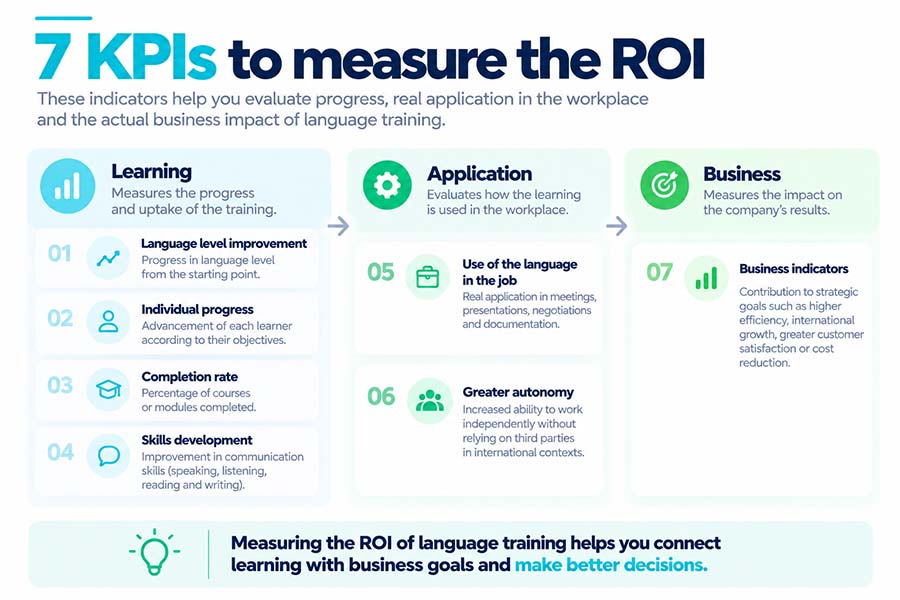
7 KPIs for Measuring the ROI of Language Training
There is no single KPI that can determine whether a language program has been cost-effective. The best approach is to combine metrics that allow you to track different stages of the process.
- Progress in language proficiency
The first indicator is, logically, to check whether the participants’ language proficiency has improved.
Comparing the initial situation with the results obtained after a training period allows you to track the progress of each employee and the organization as a whole.
For example, you can analyze how many participants have progressed from A2 to B1, from B1 to B2, or from B2 to C1.
This information demonstrates that learning has taken place, although on its own it does not yet prove a financial return.
- Individual Progress
The final level is important, but so is understanding how each person has progressed.
A corporate program may include employees at different levels, with different learning paces, and with varying professional needs. Therefore, analyzing individual progress makes it possible to identify who is making adequate progress and who may need additional support.
It also makes it possible to determine whether certain learning paths or formats are yielding better results.
- Completion Rate
The completion rate indicates how many participants complete the program as planned.
It is a relevant indicator for gauging the level of participation and identifying potential issues with engagement or program design.
However, it should not be confused with ROI.
A high completion rate does not necessarily mean a high ROI.
An employee may complete a course and then fail to apply what they’ve learned. Similarly, a shorter program can have a greater impact if it is perfectly aligned with the job’s requirements.
- Skill Development
Progress can be analyzed in greater detail by looking at specific skills.
In language learning, this may include speaking, listening, writing, reading, vocabulary, or grammar.
This information is especially useful when the training objective is related to a specific professional competency.
For example, if certain employees need to participate in international meetings, the ability to communicate orally may be more relevant than other aspects of language learning.
- Application of the language in the workplace
This is one of the most interesting indicators and, at the same time, one of the most easily overlooked.
Learning a language has professional value when the employee can use it in real-life situations.
Can you participate in an international meeting? Can you respond to a client? Can you read specialized documentation without assistance? Can you give a presentation? Can you communicate directly with other team members?
These questions help assess the transfer of learning to the workplace.
- Employee autonomy
Improving language skills can increase the autonomy of certain professionals.
An employee who previously needed help communicating with international clients may eventually be able to handle those interactions directly.
In certain contexts, this change can result in time savings, cost reductions, or increased operational capacity.
- Business Metrics
Finally, it is important to assess whether the training is linked to changes in business metrics.
Depending on the objective, metrics such as international sales, the number of customers served directly, time spent on specific tasks, translation costs, communication issues, or the capacity to take on international projects can be used.
Not all programs will allow for a direct financial correlation to be established, but the clearer the connection between the initial need and the chosen indicator, the more robust the evaluation will be.
From Learning to Results: How to Connect KPIs
A good measurement strategy does not analyze each indicator in isolation.
What’s interesting is observing the relationship between them.
For example:
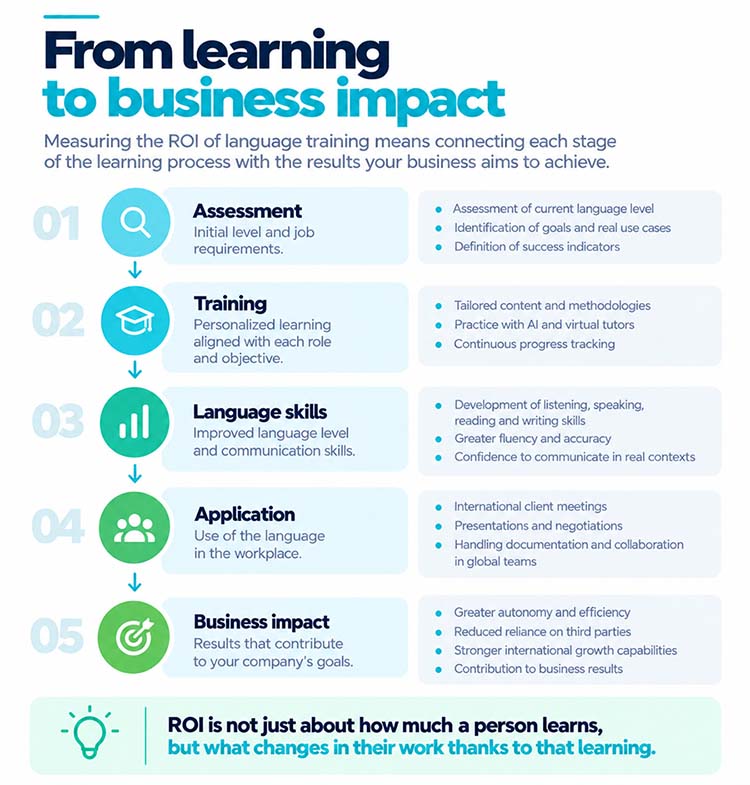
Starting level → training → skill improvement → application → business results
Let’s imagine a company that wants to increase its sales team’s ability to work with international clients.
First, the employees’ English proficiency is assessed. Then, a program tailored to their needs is developed. After a set period, the progress in their skills is measured, and an analysis is conducted to determine whether they are using the language in meetings and presentations.
Finally, the company can examine metrics related to the team’s international activities.
This methodology allows for establishing a logical relationship between training and results, rather than assuming that any subsequent improvement is a direct consequence of the course.
How to Calculate the ROI of an English Program for Employees?
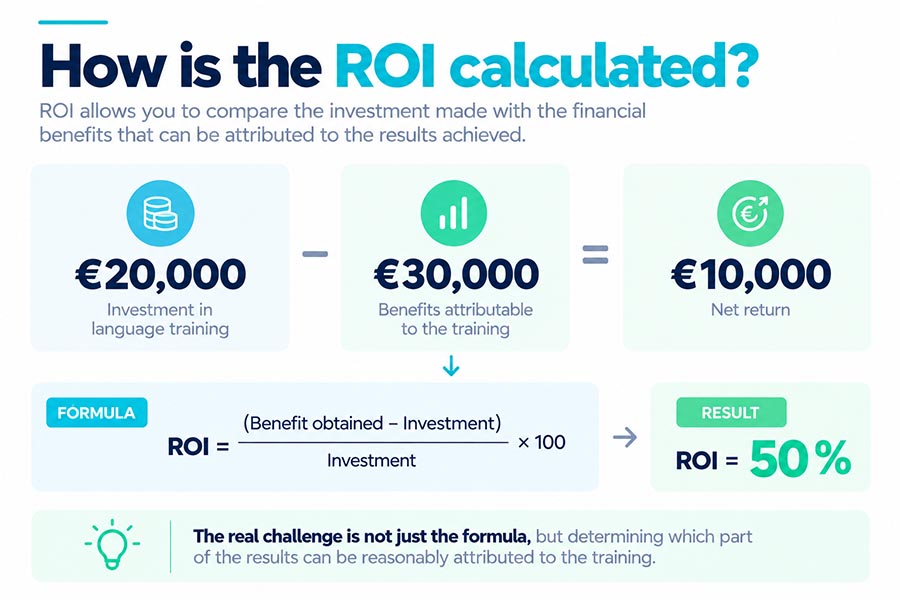
Once the data has been collected, the traditional formula can be applied:
ROI = [(benefit attributable to training – investment) / investment] × 100
Suppose a company invests €20,000 in an English training program.
During the subsequent period, it identifies €30,000 in economic benefits that can reasonably be attributed to the results of the training.
The calculation would be:
[(30,000 – 20,000) / 20,000] × 100 = 50 %
In this case, the program would have an ROI of 50%.
But this example oversimplifies an important issue: attributing financial results to a training initiative is not always straightforward.
An increase in sales, for example, can depend on multiple factors: new products, market changes, marketing campaigns, or shifts in demand.
Therefore, the ROI calculation must be based on realistic criteria and take into account other factors that may have influenced the results.
ROI and Training Metrics: They Are Not the Same Thing
One of the keys to properly evaluating a language program is to distinguish between activity, learning, application, and impact.
Stating that 500 employees have taken a course provides information about activity.
Stating that 70% have improved their proficiency provides information about learning.
Stating that a significant portion of those employees now uses the language in professional situations provides information about application.
And demonstrating that this improvement has helped reduce costs, increase autonomy, or improve specific results provides information about impact.
All four perspectives are important, but they do not mean the same thing.
That’s why a training scorecard shouldn’t focus solely on the number of participants or the hours completed.
What is a good ROI for language training?
There is no universal percentage that can determine whether a language training program has been profitable.
The result will depend on the objective, the employees’ profiles, their starting level, the program’s duration, the company’s context, and the metrics used to measure impact.
Furthermore, some benefits may appear in the short term, while others take longer to materialize.
An immediate improvement in the ability to serve international clients can be observed relatively quickly. In contrast, the impact on internal mobility, career advancement, or the ability to expand internationally may unfold over a much longer period.
For this reason, an ROI must always be interpreted within the context and the objective for which the training was designed.
The Most Costly Mistake: Training Everyone the Same Way
Let’s imagine a company with 500 employees that decides to implement a general English program.
At first glance, it seems like a good solution.
But upon analyzing the workforce, we discovered that 100 employees already have a C1 level, 150 need to reach B2, and another 250 are starting at A1 or A2 levels.
If everyone receives exactly the same program, a significant portion of the investment will be misdirected from the start.
Customization isn’t just about offering different levels. It also involves taking into account the position, responsibilities, the skills each professional needs, and the company’s objectives.
The process should begin with an assessment and continue with the appropriate allocation of content, objectives, and learning pace.
The more relevant the training is to the employee’s actual needs, the greater the likelihood that what is learned will be applied later.
How to Increase the ROI of Language Training
Measuring ROI allows you to understand the results. But it’s also possible to adjust various variables to increase the chances of achieving a good return.
Personalize Learning
A workforce is not a homogeneous group.
Employees have different levels, roles, schedules, goals, and needs. Tailoring learning to these differences allows you to focus resources where they can generate the most value.
Link the language to the job
Learning is most relevant when it addresses situations that employees encounter on the job.
Someone who manages international clients doesn’t need exactly the same English skills as someone who works primarily with technical documentation.
Linking content to the professional context makes it easier to apply the skills later on.
Set measurable goals
“Improving English” is too broad a goal.
“Enabling the team to conduct business meetings in English” allows you to set a much more specific goal and define how it will be evaluated. In fact, goals like this make it possible to tailor learning to specific language courses, such as those in the Dexway modules, which offer many courses that improve soft skills while students learn English or Spanish.
Combine learning and monitoring
Monitoring allows you to see if employees are making progress and to identify potential problems before they affect the final outcome.
Progress data also helps training managers make decisions about content, skill levels, and participation.
Measure before and after
Without a baseline, it is difficult to demonstrate progress.
A preliminary assessment allows you to establish a baseline and compare the results obtained later.
Facilitate continuity
Acquiring a language skill requires practice and continuity.
For this reason, a language program should make it easier for employees to maintain a learning routine that is compatible with their professional responsibilities.
What should a company measure when it invests in language training?
The answer will depend on the objective.
If the goal is to improve the overall level of the workforce, it makes sense to pay special attention to the development of language skills.
If the goal is to support internationalization, it will be more important to analyze the ability of specific teams to work directly with clients or colleagues from other countries.
If the goal is to prepare professionals for new responsibilities, it will be necessary to assess whether the training enables them to take on those roles.
In short, there is no universal scorecard for language training.
There is a suitable scorecard for every business objective.
From measuring courses to measuring skills
The evolution of corporate training points to a broader issue: companies don’t simply need their employees to take courses.
They need to develop the skills required by the business.
This means changing the starting point.
Instead of starting by asking: “What course can we offer?”, the question should be: “What competencies does this position require, and which ones does this person need to develop?”
From there, training can become a tool for closing existing gaps and preparing employees for the organization’s current and future needs.
When it comes to languages, this approach allows us to shift from a strategy based on offering courses to one based on developing language skills relevant to each professional profile.
The ROI of training doesn’t start with a formula
Measuring the return on investment for language training is much more than just calculating a percentage.
It starts with identifying a specific need, assessing the starting level, setting goals, selecting the appropriate training, and tracking progress.
Next, you must verify whether the skills acquired are actually being applied on the job and whether that application contributes to improving the results the company sought to achieve.
That’s why the question shouldn’t just be: “How much have we invested in language training?” . The more interesting question is: “What new capabilities does our organization now have thanks to that investment?”. When the answer can be measured with data, training ceases to be merely a budget line item and begins to become an investment linked to the real needs of the business.
Do you want to measure and improve the impact of language training?
Dexway allows you to assess employees’ proficiency levels, tailor learning to their needs, and track their progress so that organizations can manage language training with a data-driven approach.
Discover how Dexway can help you develop your organization’s language skills.