





Getting a student to start an online course is relatively easy. The real challenge is getting them to finish it. Dropout rates in online language courses remain one of the biggest challenges in e-learning and directly affect the performance of educational institutions, language schools, and companies. That is why more and more training managers are looking for solutions that can maintain motivation throughout the entire learning process.
The ability to reduce dropout rates has become a key factor when looking for training, and everyone responsible for this task is asking the same question: What should you look for in an online course to know if it helps maintain engagement and increase completion rates? Or, to put it another way, What does it do to reduce dropout rates?
Dropout Rates in E-Learning: What They Really Mean
When we talk about dropout rates in e-learning, we’re referring to when a student enrolled in a course withdraws or fails to complete it. This does not refer to students who finish a course but fail to pass it or do not achieve good results. In online courses, to put it bluntly, it’s when the student gives up.

This moment can occur in an obvious way—when a student notifies the instructor of their withdrawal—but it can also happen subtly, when the student’s progress becomes irregular. And the latter is not so easy to detect. Therefore, a disruption in learning should be understood as a decline in e-learning engagement, not merely as a complete disengagement from the course.
There’s no need to wait until the end of the course to identify that a student has fallen behind and is at risk of dropping out. E-learning courses provide comprehensive statistics on progress percentages that quickly indicate when a course is falling behind schedule and is unlikely to be completed by the planned dates. Or at least they should. And having this information is vital to being able to take action.
Main Causes of Dropout from Online Language Courses
Studies on online student retention (or dropout from online courses) point to several recurring factors that explain why students drop out of online courses or stop making progress. Research by organizations such as EDUCAUSE, OLJ and the Open University UK all point out that this occurs in the early stages of the course and is directly related to a lack of engagement, progress tracking in online language courses, and/or personalization of the learning experience.
In our experience, we have identified the following as the most common reasons for students dropping out of a language course:
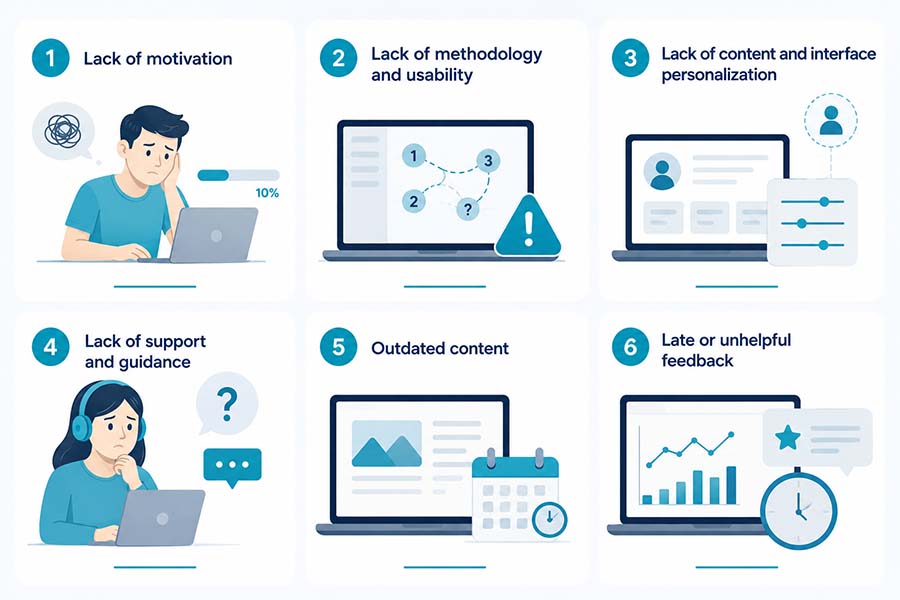
1. Lack of motivation
The enthusiasm with which many students begin their courses quickly fades if they don’t see consistent progress. This is directly related to good instructional design and an appropriate methodology.
2. Lack of Methodology and Usability
When course content does not follow a logical order and has not been created using a proven educational methodology, students perceive chaos. Similarly, a platform with a steep learning curve—or one that lacks logical and intuitive navigation—can demotivate students, as they easily get lost when trying to access or follow the course.
3. Lack of customization of content and interface
Not all students are the same, nor are they all at the same stage. That’s why a course must take its target audience into account and adapt not only its content and objectives but also its interface—which is sometimes not given the importance it deserves.
4. Lack of support
There’s nothing worse than feeling lost when faced with new material and not knowing how to resolve your questions. It’s one of the factors that contribute to dropout rates in e-learning and that most significantly impact declining participation because they nip progress in the bud.
5. Outdated content
Feeling that the scenarios presented in the course are out of date and its examples are outdated can demotivate learners.
6. Delayed feedback or feedback lacking constructive comments
Progress without feedback that addresses the learner’s progress can be discouraging because learners don’t know if they’re doing things right.
Signs That a Student or Employee Is About to Drop Out of a Course
When a student in an online course begins to show reduced engagement, there are several clear signs (learning analytics) that indicate what is happening:
- Logging in less frequently and spacing out sessions more
- Their pace of work slows down (this happens to everyone, but there comes a point where progress stops entirely)
- They avoid oral activities
- They leave assignments unfinished
- They consult fewer resources
E-learning course tracking metrics alert training managers when these problems begin to arise. But in many cases, it may be too late. What’s truly effective is having a course that has implemented the necessary strategies to drive engagement from start to finish.
Strategies for Improving Retention in E-Learning
How can you prevent dropouts in online language courses? Now that we’ve identified the most common reasons why some students decide to drop out of a language course, it’s time to explore the strategies a good e-learning course should incorporate to reduce that e-learning dropout rate that causes so much headaches for training managers.
How to Personalize Learning to Prevent Dropouts
Personalization is one of the most critical factors in retention. Adaptive learning systems allow content to be tailored to students’ actual proficiency levels, preventing both frustration and stagnation.
In Dexway language courses, this translates into dynamic AI-powered tasks where virtual native-speaking tutors adapt to the learner, personalized reinforcement exercises, and interfaces and virtual tutors tailored to the educational level.
Immediate and Comprehensive Feedback
Language learning requires constant and immediate correction to make progress. Dragging out vocabulary, grammar, or pronunciation errors makes no sense. Incorporating immediate feedback, powered by artificial intelligence, reinforces engagement.
Dexway’s AI-powered speaking and writing exercises provide instant feedback that evaluates performance on the exercises and also aims to motivate students with suggestions for improvement.
24/7 Support
The AI-powered virtual tutors ensure that students receive support at all times and can have their questions answered as soon as they arise. Available 24 hours a day in real time, these intelligent tutoring systems answer questions, help with pronunciation, and provide further information on any topic, as long as it is related to the subject at hand. Students are guided at all times, and no unresolved questions hinder their progress.
Flexibility
Many adults sign up for an online language course thinking they’ll have time to devote to it. Sometimes, a lack of time is a determining factor, and no e-learning course—no matter how good it is—can make anyone’s day longer. However, it can help people with more complicated schedules stay engaged with the course. How? By offering flexibility in terms of schedules, devices, and more.
An online course where lessons are always open, available, and accessible from a computer, tablet, or smartphone; where masterclasses are taught by AI tutors without fixed schedules; and which includes the option to take the course without a constant internet connection—all of this allows for greater freedom. When considered in light of the previous point, this makes even more sense, since guidance without fixed schedules truly allows you to progress at your own personal pace.
In this regard, Dexway’s AI conversation groups allow for unlimited practice via text chat and voice messages at any time of day, even when no other students at that level are online, thanks to AI students who act as conversation partners and chat room moderators.
Gamification Strategies in Online Language Training
Gamification is a great ally in reducing dropout rates in language learning. As long as it makes sense; otherwise, students’ motivation will quickly fade.
Progress bars, messages about course milestones, rankings with groupmates… all these kinds of things are what help maintain focus and consistency.
Dexway’s system of trophies, medals, and stars focuses specifically on course progress and milestones achieved; it also fosters healthy competition among members of the same group, when configured to do so.
Using signs of disengagement to motivate
When platforms detect a decline in student activity (progress vs. expected progress by date), you can send personalized messages to their email reminding them of aspects such as:
- the percentage of the course completed
- the topic they’ve gotten stuck on
- motivational messages to encourage them to resume studying
- suggesting supplementary resources such as podcasts, videos, or e-books to bring them back into the ecosystem
To summarize:
| Problem detected | How It Affects Students | Strategy to Reduce Dropout Rates | Some examples of how Dexway approaches this |
|---|---|---|---|
| Lack of motivation | The student stops seeing progress and loses interest in continuing. | Personalized learning, immediate feedback, goal-based gamification, and visible progress. | Medals, trophies, stars, progress bars, course milestones, and AI-powered learning experiences. |
| A poorly structured methodology or low usability | The navigation is confusing and adds to the sense of frustration. | Clear instructional design, well-structured learning paths, and an intuitive, user-friendly interface. | Courses developed using a proven pedagogical methodology, with intuitive navigation and content organized by learning objectives. |
| Lack of personalization | The content is too easy, too difficult, or not relevant enough for the student. | Adaptive learning, content tailored to the student’s actual level, and interfaces adapted to the student’s profile. | Virtual native-speaking tutors powered by AI and tailored to the student’s age, personalized exercises, and interfaces designed specifically for each educational stage and user profile. |
| Lack of support | Doubts hinder progress and reduce the continuity of learning. | AI-powered virtual tutors available 24/7 to answer questions, practice conversation, and provide guidance to students. | AI-powered virtual assistants and tutors who respond in real time, provide further explanations, and support students throughout the course. |
| Outdated content | The course loses credibility and reduces student engagement. | Up-to-date materials, real-life situations, and content aligned with the current context. | Continuous updates to the catalog with new courses (and course content), current professional contexts, and AI-powered content. |
| Late or Insufficient Feedback | The student doesn’t know if he or she is learning correctly, and this undermines his or her confidence. | Immediate feedback with personalized comments and specific suggestions for improvement. | Speaking and writing activities using AI, as well as role-play exercises, provide instant corrections, detailed feedback, and recommendations for improvement. The voice recognition exercises feature a syllable-color system that helps improve pronunciation exactly where it’s needed. |
| Lack of flexibility | Personal or work obligations make it difficult to keep up with the course. | Multi-device access, round-the-clock availability of content, and learning at the student’s own pace. | Access from computers, tablets, and smartphones; content always available (even offline); AI-powered chat groups; and unlimited practice without being tied to a schedule. |
In conclusion, dropout rates in online language courses can be addressed by offering e-learning courses with a proven methodology, artificial intelligence systems applied to language teaching that truly add value and provide relevant, up-to-date content.
Dexway courses, available in 8 languages at levels A1 through C1 and aligned with the CEFR, offer schools, universities, language schools, and large companies the expertise of a well-established and award-winning company with more than 45 years of experience in the e-learning sector. And that shows in our courses: methodology learning by doing, goal-based structure, meaningful integration of artificial intelligence, and different versions to meet different needs…
If you would like to learn how Dexway courses incorporate these strategies to improve student retention, you can request a personalized demo or contact our team.
Frequently Asked Questions About Preventing Dropouts in Dexway Language Courses
1. Why do students drop out of online language courses?
Dropout rates are often linked to a combination of factors: a lack of personalized content, a lack of ongoing follow-up, limited interaction, and unclear objectives. In many cases, it is not a conscious decision, but rather a gradual loss of engagement when the learning experience does not adapt to the learner’s pace and needs.
2. How can dropout rates in online training be measured?
Dropout is not always measured as formal withdrawal from the course. In e-learning, metrics such as completion rate, frequency of access, progress in completed units, and the level of interaction with key activities (especially speaking and practical exercises) are used. Advanced platforms incorporate learning analytics to detect patterns of early disengagement.
3. What strategies work best to increase retention in language e-learning?
The most effective strategies combine personalized learning (adaptive learning), immediate feedback, microlearning, and analytics-driven monitoring. The incorporation of artificial intelligence allows content to be tailored to the learner’s level, improves conversational practice, and anticipates potential dropouts before they occur.
4. What role does artificial intelligence play in student retention?
Artificial intelligence helps improve retention by offering personalized learning paths, adaptive assessments, and virtual tutors available at any time. It also helps detect signs of disengagement through behavioral analysis, allowing for proactive intervention to prevent dropouts.
5. How can educational institutions reduce dropout rates in their online language courses?
Institutions can reduce dropout rates by combining a strong onboarding strategy, continuous student monitoring, clear objectives from the start, and technological tools that allow for progress tracking. Integrating AI-powered platforms with LMS systems provides a comprehensive view of learning and enables real-time corrective actions.