





Learning a language encompasses far more than merely memorizing vocabulary or grasping grammatical structures. To cultivate genuine communicative competence, students must actively engage with the language, respond to diverse situations, and learn to navigate conversations that do not adhere to a predictable script. Nevertheless, allocating sufficient time for oral practice continues to be one of the most significant challenges in language instruction. Factors such as the number of students in each group, the duration of classes, and the complexities of organizing individual conversations frequently restrict opportunities for meaningful interaction.
AI-powered role-plays, such as those found in Dexway language courses, provide a novel approach to enhancing this practice. By engaging in simulated scenarios with AI virtual tutors, students can encounter realistic communicative situations, converse with a virtual interlocutor, and repeat the experience as often as necessary.
It is not a matter of substituting interaction with teachers or peers, but rather of integrating an additional tool that facilitates greater practice, enabling independent engagement and the application of learning in real-world language contexts.

What is the Role of AI in Language Learning through Role-Playing?
A role-play is an activity in which the student assumes a specific role within a defined context and must engage in communication to accomplish a goal. For instance, they may portray a traveler needing to alter a reservation, a candidate involved in a job interview, or a professional tasked with explaining an issue to a client.
In traditional education, these activities usually occur between two students or between a student and a teacher. With the advent of artificial intelligence, one of the participants may be virtual. The system analyzes the student’s responses and advances the dialogue based on the student’s input.
This enables us to transition from an exercise with fixed responses to a significantly more dynamic interaction.
The fundamental reasoning is straightforward:
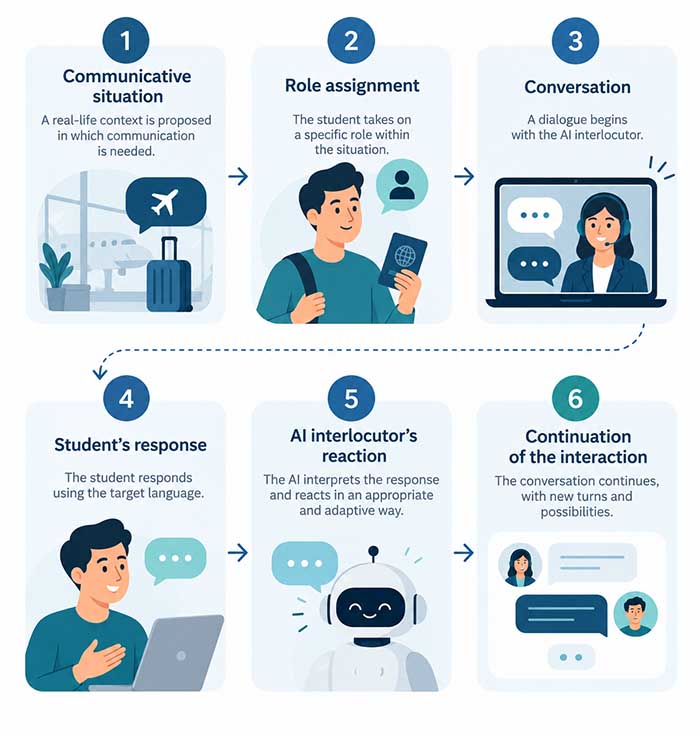
This approach aligns seamlessly with the action-oriented perspective of the Common European Framework of Reference for Languages (CEFR). The Council of Europe perceives the learner as a social agent who employs language to communicate, collaborate, construct meaning, and accomplish objectives in real-world contexts.
Therefore, the pedagogical significance of role-play resides not merely in “interacting with an AI,” but in immersing the student in a contextualized communicative task that necessitates active language use.
Transitioning from Predefined Dialogue to a More Open Conversation
Dialogue exercises have been integral to language courses for decades. They serve as effective tools for introducing common structures, vocabulary, and expressions; however, they possess a notable limitation: the flow of conversation is typically predetermined.
The student is aware, in one manner or another, of the type of response that is anticipated.
In an AI-driven role-play, the dialogue can progress according to the student’s choices. An unforeseen response may prompt a new inquiry, a request for clarification, or a shift in the scenario’s trajectory.
This element of unpredictability is significant as it more accurately reflects the dynamics of language use outside an educational context. In genuine conversations, we cannot precisely anticipate what our interlocutor will inquire about or how they will react to our statements.
Dexway integrates this practice into its artificial intelligence language tools, which include speaking, writing, virtual tutoring, and conversation classes.
Explore Dexway’s Artificial Intelligence Tools
1. Increased opportunities for language practice
One of the primary advantages of AI-powered role-plays is straightforward: they enable students to enhance the duration of their active language use.
In a one-hour in-person class with multiple students, the effective duration for individual oral production can be quite brief. Even when activities are structured in pairs or groups, each student has a restricted amount of time to articulate their thoughts.
Engaging with AI creates an extra opportunity for personal practice. The student can initiate a dialogue as required, complete a scenario, and subsequently revisit it.
This potential is particularly advantageous when the objective extends beyond mere comprehension of content to the automation of communication skills. Articulating thoughts fluently necessitates prior practice of conversational structures, vocabulary, and strategies on numerous occasions.
Technology enables repetition to be independent of the teacher’s availability.
2. Engage in authentic communicative scenarios
Another pertinent advantage is the ability to situate learning within a familiar context.
An activity may require the student to discuss their vacation. Conversely, a role-play might position them at a hotel reception desk due to an issue with their reservation. In that scenario, a clear objective arises: to articulate the situation, request a resolution, and respond to the options presented by the other party.
Language transforms from being the isolated objective of the exercise into an essential tool for addressing a situation.
This methodology facilitates engagement with a diverse array of scenarios:
- a professional interview;
- a formal meeting;
- a dining reservation;
- a meeting in a hotel;
- a dialogue during a journey;
- a customer service issue;
- a polished presentation;
- a negotiation or inquiry for information.
The significance of context also facilitates engagement with languages tailored to specific professional objectives. For instance, Dexway’s purpose-driven courses encompass fields such as hospitality, information technology, digital marketing, office administration, and job interviews.
3. A Secure Environment to Conquer the Fear of Speaking
One of the most common challenges in language acquisition is not linguistic but emotional: the learner is aware of specific structures yet refrains from employing them due to the fear of making errors. Speaking in front of a classroom, responding promptly to an instructor, or engaging in dialogue with a more advanced peer can induce feelings of insecurity. This may diminish participation, particularly among those students who require the most practice.
AI-assisted role-playing provides a less socially demanding environment. Students can experiment with answers, make mistakes, rephrase their responses, and engage in the activity repeatedly without the pressure often associated with public discussions.
This does not imply that human interaction is no longer essential. On the contrary, engagement with AI can serve as a preparatory step for future communication scenarios with others.
A student can initially practice a job interview through role-playing and subsequently engage in the same activity with classmates in the classroom. AI serves as an intermediary platform bridging theoretical knowledge and interpersonal interaction.
4. Tailor the practice to the student’s proficiency
Not all students should encounter the same linguistic challenges.
An A2 level student may require straightforward scenarios, featuring direct inquiries and familiar vocabulary. Conversely, a B2 or C1 level student should possess the ability to articulate arguments, elucidate nuances, address counterarguments, and engage in more intricate discussions.
Artificial intelligence facilitates enhanced flexibility in this process. The context, vocabulary, interlocutor interventions, and the complexity of situations can all be tailored to align with the learning level and objectives.
This progression is particularly significant when courses are organized in accordance with the CEFR. Dexway categorizes its offerings by levels from A1 to C1, facilitating the creation of coherent learning pathways and the adaptation of skills to each stage of the educational process.
Personalization, therefore, extends beyond merely recommending diverse content. It also influences the manner in which that content is utilized and the degree of engagement necessitated.
5. Conversations that are less predictable and more reflective of reality
In numerous conventional digital activities, there exists only one correct answer or a limited range of options.
This form of exercise continues to be beneficial for specific objectives, particularly when it is essential to assess grammar, vocabulary, or comprehension. However, its effectiveness diminishes when the aim is to develop conversational skills.
A genuine interaction necessitates continuous decision-making. The student must comprehend what they have just heard, determine what they wish to convey, choose the appropriate words, and construct a response within a limited timeframe.
AI role-plays facilitate the introduction of this very variability.
Envision a scenario in which a student is required to request a room change at a hotel. They may assert that there is excessive noise, that the room does not correspond to their reservation, or that they require particular amenities. Each response has the potential to guide the conversation in a distinct direction.
Learning is no longer exclusively focused on identifying the correct answer; it now emphasizes the development of a different skill: the ability to respond effectively using the language.
6. Enhanced Immediate Feedback
Practice is most beneficial when the student comprehends the areas in which they need to enhance their skills.
Artificial intelligence technologies utilized in language learning facilitate the automation of specific analysis and evaluation processes. Depending on the activity and the solution employed, they can deliver insights into aspects of oral or written expression and provide immediate feedback following practice.
At Dexway, the AI capabilities encompass speaking and writing exercises with automatic evaluation, alongside conversation simulations and role-playing scenarios. The platform further incorporates tutoring and progress monitoring tools.
Immediacy offers a significant pedagogical advantage by minimizing the gap between practice, error identification, and subsequent practice.
The student is able to engage in an activity, receive instruction, and attempt again while the experience remains fresh.
However, it is essential to regard automated assessment as a supplementary tool. The evaluation of specific complex communication skills still necessitates a pedagogical context and, in many instances, the involvement of a teacher.
7. Enhanced Autonomy Within and Beyond the Classroom
Traditionally, a significant portion of communicative practice relied on the physical environment of the classroom.
Digital environments enable us to transcend this limitation. Students can conduct simulations from home, prepare activities prior to attending class, or strengthen areas where they have faced challenges.
This supports methodologies such as blended learning or the flipped classroom.
For instance, the instructor may introduce a communicative scenario prior to class. Each student engages in a role-play with AI individually, arriving in the classroom with prior experience. The in-person class time can subsequently be utilized to compare strategies, rectify common errors, or collaboratively navigate a more intricate version of the exercise with peers.
The value of technology becomes evident when it enables teaching time to be allocated to activities where human involvement provides greater significance.
Examples of AI Role-Playing for Language Acquisition
The possibilities are contingent upon the student’s level and objectives, yet they can be tailored to reflect common scenarios encountered in daily, academic, or professional life.
A student acquiring a language for travel may practice checking into a hotel, purchasing a ticket, or inquiring about directions. A professional can prepare for a job interview, articulate a project, or manage a call with a client.
It is also feasible to gradually adjust the difficulty of the same scenario.
In a job interview for a mid-level position, the interviewer may inquire about the candidate’s professional experience or educational background. At more senior levels, they may pose unexpected questions, seek justification for a decision, or request specific examples.
The crucial aspect is not to amass scenarios, but to construct them with a distinct communicative objective in mind.
What advantages does AI provide in comparison to traditional role-play?
Framing this issue as a rivalry between artificial intelligence and educators results in a flawed conclusion.
The two formats present distinct advantages.
Role-playing encompasses the intricate nuances of human interaction, including nonverbal communication, spontaneity, collaboration, negotiation, and a diverse array of communication styles. Additionally, it enables the educator to intervene directly and modify the activity in response to their observations within the classroom.
AI introduces additional capabilities: accessibility, consistency, scalability, and the potential to provide each student with a personalized practice environment.
Consequently, a notably intriguing model entails the integration of both environments.
The student can engage in prior practice with a virtual partner, rehearsing a scenario multiple times to build confidence. Subsequently, they can apply that knowledge to a paired activity, a group discussion, or a presentation overseen by the instructor.
Technology does not replace human practice; rather, it can assist students in arriving better prepared for it.
Utilizing AI Role-Plays Before, During, and After Class
Role-plays need not exist as a standalone activity within a platform; rather, they can be integrated into a more comprehensive learning sequence.
Prior to the class, they can serve as preparatory tools. The student becomes acquainted with the vocabulary and is introduced to a scenario that will subsequently be discussed in a group setting.
During the class, the instructor can utilize that experience as a foundation to examine various response strategies, review frequent errors, or suggest new variations of the scenario. Students may also reenact the situations they have previously practiced in person.
After class, role-playing facilitates the reinforcement of the material. A student who has encountered challenges can independently repeat a simulation until they achieve greater proficiency.
The same tool consequently serves various functions based on the timing of its integration into the training process.
The Teacher’s Role in AI Role-Playing
The presence of artificial intelligence does not diminish the necessity for instructional design. In fact, as the tool’s capabilities increase, the importance of determining its intended applications becomes even more critical.
The educator persistently delineates objectives, selects activities, contextualizes learning, and discerns when a student requires a particular explanation or intervention.
Artificial intelligence can assume responsibility for certain repetitive tasks related to practice and specific automated assessments. This enables a greater allocation of time to activities such as analyzing challenges, formulating communication strategies, fostering participation, or offering personalized support to students.
The pertinent question, therefore, is not how extensively AI can supplant the teacher, but rather how it can enhance the learning opportunities that the teacher is capable of providing.
Role-Playing and Artificial Intelligence in Dexway Courses
At Dexway, AI role-playing is an integral component of a comprehensive ecosystem of AI tools designed to enhance communication skills.
AI solutions seamlessly integrate role-playing, conversation classes, speaking and writing activities with automated assessment and virtual tutoring. Certain versions, including Dexway AI Masterclass & Practice and Dexway AI English Practice, specifically embed these activities within their learning pathways.
This approach is significant because artificial intelligence gains enhanced educational value when aligned with the objectives, content, and level of the course, rather than operating as a chatbot detached from the learning process.
The ultimate objective remains unchanged: to guarantee that the student increasingly utilizes the language effectively and can apply their acquired knowledge to real-life scenarios.
Common Inquiries Regarding Role-Playing and Artificial Intelligence
What constitutes a role-play involving artificial intelligence?
It is a simulation in which the student assumes a role within a specified scenario and engages in dialogue with an AI-generated interlocutor. The interaction can develop according to their responses, enabling them to practice the language in a communicative context. In Dexway AI role-playing games, the virtual tutors…
In what ways does AI assist with speaking practice?
It facilitates the generation of supplementary conversational opportunities without the continual reliance on the availability of a teacher or peer. Students can engage in individual practice, revisit scenarios, and, in specific systems, obtain automated feedback on their verbal output.
Do AI-driven role-plays supplant educators?
No. They are particularly beneficial as a supplement to instructional activities. They facilitate prolonged independent practice while the educator engages in tasks such as lesson planning, providing support, analyzing challenges, and developing more intricate communicative activities.
Can role-plays be tailored to the student’s proficiency level?
Yes. Scenarios can be crafted with differing levels of difficulty, vocabulary, and communicative complexity. This enables engagement in activities that range from basic interactions at beginner levels to professional dialogues or situations necessitating argumentation at advanced levels.
What scenarios can be practiced?
Almost any circumstance that can be framed as a communicative interaction: travel, dining establishments, meetings, job interviews, customer service, presentations, social dialogues, or situations pertinent to specific professional fields.
Can AI role-playing be applied beyond the classroom?
Indeed, that is one of its primary advantages. It can serve as preparation for a class, function as an independent activity, or provide subsequent reinforcement, thereby supporting online, blended, and flipped classroom models.
What distinguishes an AI-driven role-play from a scripted dialogue?
In a structured dialogue, response options are typically constrained, and the trajectory is established in advance. In an AI-driven role-play, the conversation can adapt to the student’s replies and develop in various directions, fostering a more dynamic experience that resembles authentic interaction.
Artificial intelligence enables role-playing to extend beyond confined exercises, evolving it into a more adaptable, contextualized practice environment accessible to every student. In Dexway courses, these experiences are seamlessly integrated with additional AI tools and a structured methodology, ensuring that technology enhances language acquisition. Contact us for further information.