





Artificial intelligence is no longer just a technology we saw coming—it has become a common tool that is already having a real impact on education. In language teaching, its application makes it possible to personalize learning, offer much more continuous practice, and provide detailed tracking of each student’s progress.
But its value goes far beyond automating tasks. AI is helping to solve some of the main challenges in language learning: adapting content to different levels, providing immediate feedback, facilitating oral practice, and improving student motivation to reduce dropout rates. Dexway language courses integrate all of these smart tools.
In this article, we explain what artificial intelligence is when applied to language teaching, how it is currently used, what benefits it offers to schools, universities, and companies, and what the best practices are for integrating it into educational programs.

How does artificial intelligence contribute to language teaching?
Artificial intelligence improves language learning because it allows for:
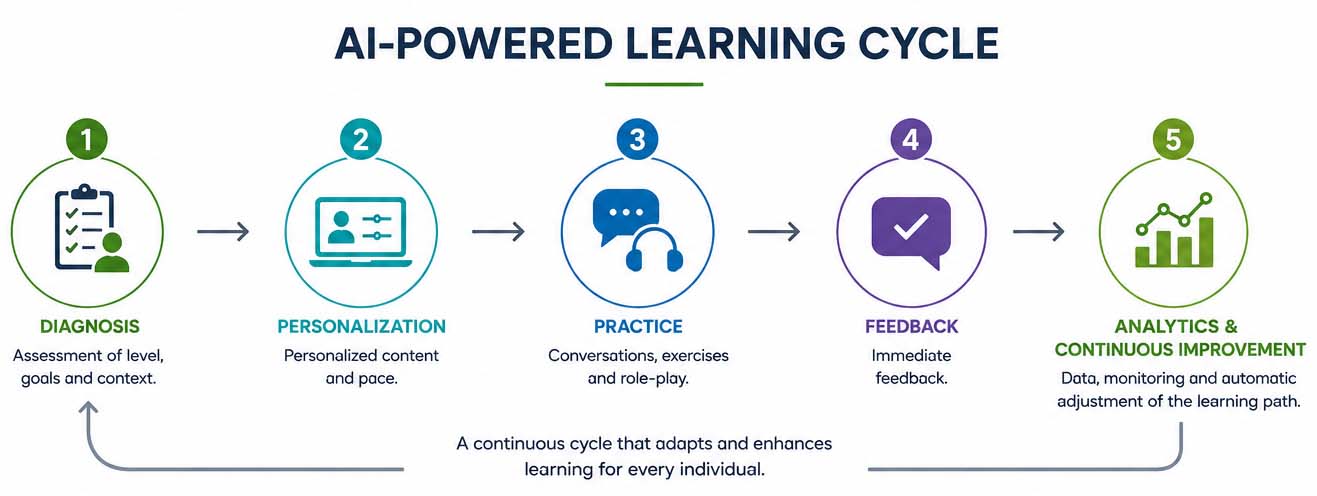
- Customizing content based on each student’s level, goals, and pace.
- Automatically correct pronunciation, spelling, and specific language skills, including personalized comments and recommendations that boost student motivation.
- Generate exercises, conversations, and activities tailored to the student’s context, which evolves to match each student’s progress.
- Provide immediate feedback to accelerate learning, so students don’t have to wait until the next class to have their questions answered.
- Analyze progress using objective data.
- Increase opportunities for oral practice without relying on class schedules, teacher availability, or social pressure.
- Optimize the work of teachers and training coordinators through monitoring and automation tools.
The result is a learning experience that is more flexible, effective, and focused on the real needs of each student.
What is artificial intelligence applied to language teaching?
Artificial intelligence (AI) encompasses technologies capable of analyzing information, learning from data, and automatically generating responses or recommendations.
In the field of language learning, these capabilities make it possible to create learning experiences that are much more dynamic than traditional models. The platform can interpret how each user learns, identify their difficulties, and adapt the content to help them progress more efficiently.
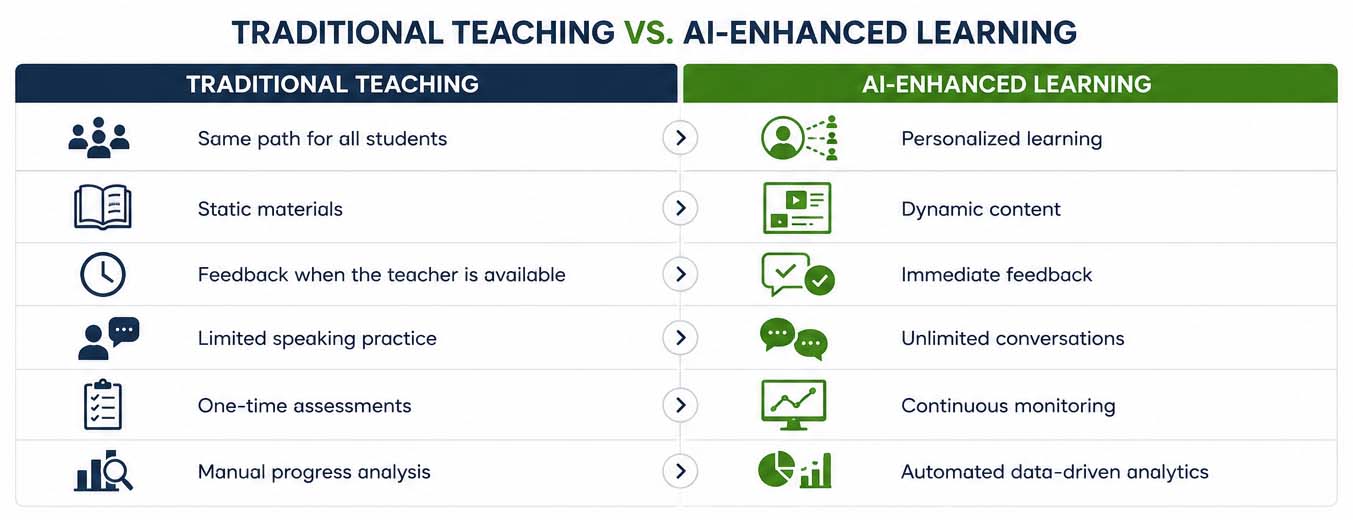
Unlike a static course, where all students follow the same path, an AI-based solution continuously adjusts the learning experience to deliver the right content at the right time.
How Is Artificial Intelligence Used in Language Teaching?
Currently, AI is applied in virtually every stage of learning, from content generation to progress assessment.
Conversations with Virtual Tutors
Oral practice is one of the most difficult aspects to develop when students don’t have conversation partners.
Dexway’s virtual tutors, powered by artificial intelligence, allow students to have unlimited conversations tailored to their level and focused on real-life situations, both personal and professional.
In addition to responding naturally, they can detect errors, suggest alternatives, and offer recommendations to improve spoken expression: Dexway’s feedback goes beyond mere correction to include suggestions for improvement.
Automatic Pronunciation Correction
Thanks to automatic speech recognition, AI can analyze how the student pronounces each word and compare it to native models.
This technology identifies phonetic errors, intonation or rhythm issues, and provides immediate feedback to improve oral communication.
Students can repeat each exercise as many times as necessary, promoting consistent and independent practice.
Automatic Generation of Exercises and Content
Generative AI allows for the creation of instructional materials in a matter of seconds.
Among other possibilities, it can generate:
- comprehension exercises;
- grammar activities;
- vocabulary exercises;
- contextualized dialogs;
- professional role-plays;
- texts adapted to different levels;
- assessments and rubrics.
This capability facilitates the continuous updating of content and allows for a quick response to specific training needs.
Continuous and Analytical Assessment of Learning
Every student interaction generates useful information for improving the training.
Artificial intelligence-based platforms can identify learning patterns, detect the risk of dropouts, measure progress by skill, and generate reports that help both students and teachers make better decisions.
For universities, companies, and educational institutions, this analytics makes it easier to manage large groups of students without losing track of individual progress.
What are the benefits of AI for language learning?
The incorporation of artificial intelligence offers benefits for both students and the organizations that provide training. Among the main advantages are:
- learning adapted to each student’s pace;
- more oral practice;
- immediate feedback;
- content that is always up to date;
- greater motivation;
- reduced dropout rates;
- detailed progress tracking;
- optimization of teaching resources;
- the ability to scale training programs to accommodate thousands of students.
The combination of these advantages enhances the learning experience and increases the effectiveness of language programs.
Traditional Teaching vs. AI-Supported Teaching
Can artificial intelligence replace a language teacher?
No. Artificial intelligence does not replace the teacher.
AI is a support tool that automates processes such as grading, generating activities, and conversation practice, but the teacher’s role remains essential.
The teacher provides context, develops communication skills, fosters critical thinking, and adapts the methodology to the group’s needs. It gives teachers the tools to devote more time to the tasks where they truly add value: guiding, motivating, supporting, and developing communication skills.
The greatest effectiveness is achieved when technology and teachers work in a complementary manner.
How to integrate AI into a language teaching program?
The incorporation of artificial intelligence must serve clear pedagogical objectives and not merely the adoption of new technologies.
Some recommendations for effective implementation include:
- defining which processes will truly benefit from automation;
- using AI to complement existing methodology;
- combining self-directed learning with teacher guidance;
- training teachers in the use of these tools;
- establish transparent criteria for assessment;
- foster critical thinking and the responsible use of AI.
Technology provides efficiency, but it is the methodology that determines the quality of learning.
What benefits does AI offer universities, educational institutions, and companies?
Organizations that train large groups find artificial intelligence to be a particularly valuable tool.
It allows for personalized learning without a proportional increase in teaching resources, automates administrative processes, analyzes results in real time, and offers a more flexible learning experience.
In addition, it facilitates the implementation of hybrid models that combine in-person and online learning, making it possible to expand educational offerings and better meet the needs of students and professionals.
Frequently Asked Questions About Artificial Intelligence and Language Learning
Does artificial intelligence really improve language learning?
Yes. When used as part of an appropriate teaching methodology, AI facilitates more consistent practice, personalizes learning, and provides immediate feedback—all of which contribute to improving student progress.
What skills can AI assess?
Currently, it can assess skills such as pronunciation, comprehension, vocabulary, grammar, writing, and—with increasing accuracy—certain aspects of oral communication.
Can it generate exercises tailored to the student’s level?
Yes. AI makes it possible to automatically create activities tailored to each student’s language level, learning objectives, and individual progress.
Is it useful for online learning?
Especially so.
Artificial intelligence increases student engagement, improves personalization, and facilitates ongoing monitoring—all of which are essential for maintaining motivation in digital learning environments.
Can it also be applied to in-person training?
Yes. More and more institutions are using AI to complement in-person classes, expanding opportunities for practice outside the classroom and providing a continuous learning experience.
The Future of Language Teaching Is Already Here
Artificial intelligence is redefining the way we learn languages. It’s no longer just about incorporating new technologies, but about offering a more personalized, flexible, and effective experience for each student.
Organizations that integrate these capabilities will be better prepared to meet students’ new expectations, improve academic outcomes, and optimize the management of their training programs.
In this context, specialized platforms play a key role. Solutions like Dexway integrate artificial intelligence into a proven learning methodology, combining virtual tutors, speech recognition, automated assessment, contextualized conversations, and adaptive learning to offer a more comprehensive, practical, and results-oriented language training experience.
Artificial intelligence does not replace teachers in language learning—it enhances it.